Went up the Blue Mountains with mates. Was way hot, like 45°+ hot in Sydney and ~10° or so colder 1.3Km higher up in the sky in the mountains.
Sat on the floor and chatted, drank, sat, chattered, drank. Watched some Red Dwarf, sat and drank more. Ate an amazing amount of BBQ meat drank and ate. Repeat again for New Years Day.
Came home to Sydney and the devastation that heat wrought.
Garden looks like it has been blow torched. Beautiful Coppers Tree Ferns (Cyathea cooperi) that can withstand 40°C for several days all have frond scorch but look like they will survive. All the spiders and most of the other bugs and critters are dead and I’ve not seen any of the geckos (Phyllurus platurus) or smaller skinks that are usually busy doing their herpetological thing. We are right on the Lane Cove National Park so some of the larger animals like the Blue Tongue Lizards, possums, and all the birds we see have put in an appearance but without the little scurrying thinks they normally eat I imagine that they’ll stay away until the critters populations can rebuild.
Tuesday, December 20, 2005
Back pain?
Back pain? - Excruciating muscle cramps?
Been to Queansland? perhaps you've been stung by one of these:
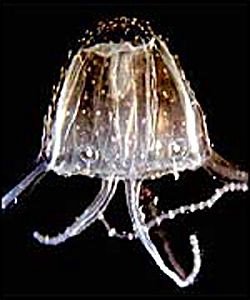
Continuing with the jellyfish theam. These cute little Australians pack a punch. They even have their own syndrome named after them. The SMH reports that some people have been stung in Queansland over the last few dayz. I want to know if anybody has ever died from stings from the strange concentrations of blobs of purple jelly encountered surffing in Sid-en-nee beaches from time to time. One Bondi local caleld them purple people eaters. The are kind of like a blue bottle but with no air bladder and no tenticles. More of a concentrically ribbed transpearent disk with a ridge like sail and stinging purple edges.
The origional SMH article is here: Jellies attack Queansland
I put the whole text under the fold if it disappears.
----
update: they have now found a breeding ground collected venom and a few thousand embreos.
More
Four people have been stung by potentially deadly irukandji jellyfish off central Queensland within the last few days.
Surf Lifesaving Queensland's spokesman for the Wide Bay-Capricorn region Craig Holden said today the people were stung by the tiny jellyfish at Agnes Water beach, which has been closed as a precautionary measure.
Mr Holden said reopening the beach, which was closed following a similar jellyfish problem four years ago, would be considered as a day-to-day proposition.
"That was the one-off and we haven't had them since and haven't had them before that," he said.
Irukandji stings cause severe lower back pain, excruciating muscle cramps in legs, arms, abdomen and chest, and nausea, vomiting, headaches and palpitations.
They can also cause cardiac failure.
In 2002, two tourists - a Briton and an American - became the first recorded fatalities from irukandji stings after separate encounters in Far North Queensland.
Been to Queansland? perhaps you've been stung by one of these:

Continuing with the jellyfish theam. These cute little Australians pack a punch. They even have their own syndrome named after them. The SMH reports that some people have been stung in Queansland over the last few dayz. I want to know if anybody has ever died from stings from the strange concentrations of blobs of purple jelly encountered surffing in Sid-en-nee beaches from time to time. One Bondi local caleld them purple people eaters. The are kind of like a blue bottle but with no air bladder and no tenticles. More of a concentrically ribbed transpearent disk with a ridge like sail and stinging purple edges.
The origional SMH article is here: Jellies attack Queansland
I put the whole text under the fold if it disappears.
----
update: they have now found a breeding ground collected venom and a few thousand embreos.
More
Four people have been stung by potentially deadly irukandji jellyfish off central Queensland within the last few days.
Surf Lifesaving Queensland's spokesman for the Wide Bay-Capricorn region Craig Holden said today the people were stung by the tiny jellyfish at Agnes Water beach, which has been closed as a precautionary measure.
Mr Holden said reopening the beach, which was closed following a similar jellyfish problem four years ago, would be considered as a day-to-day proposition.
"That was the one-off and we haven't had them since and haven't had them before that," he said.
Irukandji stings cause severe lower back pain, excruciating muscle cramps in legs, arms, abdomen and chest, and nausea, vomiting, headaches and palpitations.
They can also cause cardiac failure.
In 2002, two tourists - a Briton and an American - became the first recorded fatalities from irukandji stings after separate encounters in Far North Queensland.

Monday, December 19, 2005
Smacks for you

Giant jellies attack Japan
More
Stolen verbatim from here: http://www.cdnn.info/news/eco/e051208a.html.
TOKYO, Japan (8 Dec 2005) -- THEY are called echizen kurage and they sound like monsters from the trashier reaches of Japanese science fiction.
They are 6ft wide and weigh 450lb (200kg), with countless poisonous tentacles, they have drifted across the void to terrorise the people of Japan. Vast armadas of the slimy horrors have cut off the country's food supply. As soon as one is killed more appear to take its place.
Finally, the quarrelsome governments of the region are banding together to unite against the enemy.
Echizen kurage is not an extraterrestrial invader, but a giant jellyfish that is devastating the livelihoods of fishermen in the Sea of Japan. Nomura's jellyfish, as it is known in English, is the biggest creature of its kind off Japan and for reasons that remain mysterious its numbers have surged in the past few months.
The problem has become so serious that fishery officials from Japan, China and South Korea are to meet this month for a "jellyfish summit" to discuss strategies for dealing with the invasion. Japan's ruling Liberal Democratic Party has formed a jellyfish countermeasures committee and fishermen are at work on technology to keep the marauders out of their nets.
The problem first became obvious in the late summer when fishermen chasing anchovies, salmon and yellowtail began finding huge numbers of the jellyfish in their nets.
Often the weight of the echizen kurage broke the nets or crushed the fish to death; those that survived were poisoned and beslimed by their tentacles.
Fishermen on the northern tip of Honshu, Japan's main island, were forced to suspend work at the height of the lucrative salmon season.
In Akita prefecture some communities saw their incomes fall by 80 per cent. The gizzard shad fishers of South Korea have also been plagued by the Nomura's.
In some places jellyfish density is reported to be a hundred times higher than normal. Worst of all, no one yet understands why. One theory is that global warming is heating up the seawater and encouraging jellyfish breeding.
Some observers blame heavy rains in China over the summer, which flowed out from rivers and propelled abnormal numbers of jellyfish towards Japan. Nutrients in its river water may have given them extra zip — or overfishing has allowed the growth of the populations of plankton on which the jellyfish feed.
Screens and meshes have been designed that allow fish through but keep out anything bigger, and a web of metal wires can be placed inside a net to chop the jellyfish to pieces.
In the meantime locals are making the best of it — rather than just complaining about jellyfish they are eating them.
Jellyfish are an unusual ingredient of Japanese cuisine but are much more prized in China. Coastal communities are doing their best to promote jellyfish as a novelty food, sold dried and salted.
Students in Obama have managed to turn them into tofu, and jellyfish collagen is reported to be beneficial to the skin.
SEA MONSTERS
# The most poisonous jellyfish is the Australian sea wasp, or box jellyfish, with enough venom to kill 60 people. Wearing tights is an effective defence
# The largest jellyfish ever found was a lion's mane, with a bell 2m (7ft) across, and tentacles extending more than 35m
# The notorious Portuguese man o'war is not a jellyfish at all but a collection of different organisms including stinging tentacles
# Jellyfish have both male and female characteristics. A group releases sperm and eggs which mix in the water
# A collection of jellyfish is known as a smack
Monday, December 05, 2005
Subscribe to:
Posts (Atom)


